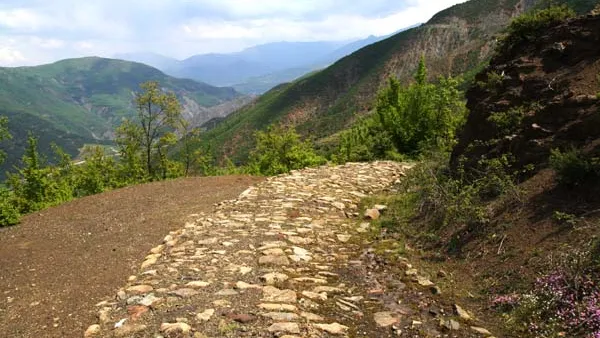

In the hush of high-mountain air, where the stone-terraced fields of Albania meet the sky, there lives a word as ancient as the ancestors: Besa. In its simplest form, the word means “to keep the promise”. But in the Albanian soul it is far more: it is a covenant of honour, a vow placed by one human being on the life of another, the life of one’s guest or wanderer, to shelter them, to guard them, to lay down one’s own safety for their sake.
In a stranger’s knock at the door of a mountain home, when both were bound by neither blood nor faith, the host hears the word of Besa. The hearth is lit, the guest is welcomed, the night is given. The promise is sealed—not in ink or ledger, but in dignity. “One who acts according to besa is someone to whom one can trust one’s life and the lives of one’s family.”
Besa is more than hospitality: it is the ethical backbone of mutual trust. To break it is to lose one’s face in the community; to uphold it is to claim the highest possible virtue. It is spoken quietly in mountain villages, passed in the steady gaze of elder women and wise men, carried without fanfare. And when the storm rages—be it war, famine, or fear—Besa endures, rooted in the soil of the Albanian heart.
When Darkness Came: Jews in Albania during WWII
Against the backdrop of destruction and persecution across Europe during the Second World War, the story of Albania shines as an extraordinary exception. The small Balkan country—though occupied by Italian and then German forces—became a sanctuary guided by the principle of Besa. Refugees fleeing Nazi-terror found their way to Albanian villages and towns. The local families took them in, sheltered them, supplied false papers, hid them in mountain homes. The rescuers refused to hand over lists of Jews to the occupiers. [1] One widely-cited assessment states: “Albania, a European country with a Muslim majority, succeeded in the place where other European nations failed … almost all Jews living within Albanian borders during the German occupation … were saved.”[2]
It was on the foundation of Besa that this astonishing outcome emerged. “Besa dictates there are no foreigners, only guests. And, guests must be protected at all costs.”[3] Thus, when the Germans demanded lists of Jews, when the pressure mounted, when fear stalked the land, some Albanian families stood firm, sheltered their guests, honoured their vow. A German report noted the difference: in Albania proper, nearly all native Jews and foreign Jewish refugees survived. [4]
This is not to say there were no tragedies; there were. But compared to much of occupied Europe, the survival rate was exceptional, and the credit is often given to a cultural-ethical foundation: Besa.
Dr. Sabri Tefiku (1886-1954) — healer, builder, Albanian soul
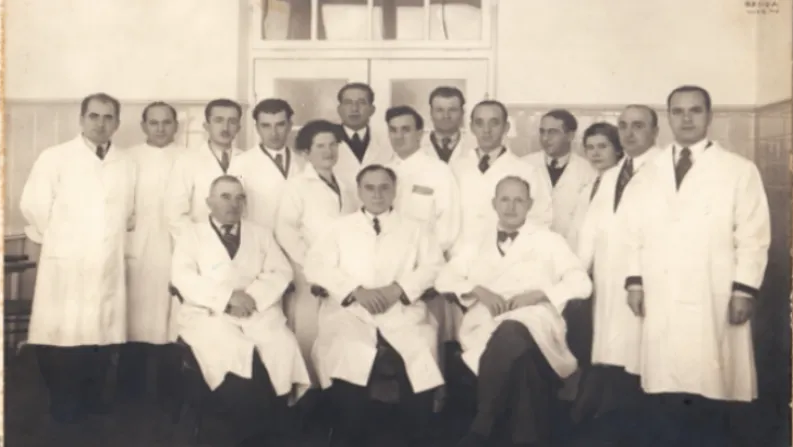
In this tapestry of honour and humanism, one thread is my grandfather, Dr Sabri Tefiku—a figure of dedication, learning, and patriotism. Born in Tirana in 1886, he took his early studies at the Zosimea Gymnasium in Janina, then proceeded to complete his medical faculty studies in Istanbul in 1911.
In 1928, he went to Paris for specialization at the Institut Cochin. By 1932, when the new Civil General Hospital in Tirana opened, he began working there as a pathologist, later becoming its General Director in 1937 [5].
It was in that role that he demonstrated not only clinical excellence but visionary leadership: he lobbied to bring foreign doctors to Albania, including leading specialists, which laid a key foundation for the development of neurosurgery in the country. A recent study of neurosurgical history in Albania notes his presence on the 1935 staff of the King Zog I Hospital, alongside Prof. Walter Lehmann and Dr Sabri Tefiku. (Nico, et al., 2023). Though acclaimed as a skilled physician, he suffered the consequences of changing regimes and post-war upheaval. [6]
A Brother in Exile, a King’s Respect, and a Lifeline in a Time of Peril
The life of Dr Sabri Tefiku cannot be separated from the political currents of Albania in the early 20th century. His brother, Haki Tefiku, was a committed Republican who opposed the monarchy and, for that reason, was exiled by King Zog. Yet even in the midst of deep ideological division, respect and dignity sometimes prevailed where politics did not.
King Zog held extraordinary regard for Dr Sabri, whose reputation as a physician was not merely that of technical skill — he was known for his calm judgement, moral clarity, and dedication to public service. His integrity transcended politics. The King personally urged him to leave private practice and assume leadership of the Civil General Hospital of Tirana. The King believed that the hospital — and the future of Albanian medicine — required a man of his discipline and vision. And Dr Sabri accepted the call.
It was in this position, however, that Dr Sabri’s leadership intersected with one of the darkest chapters in European history.
As Jewish physicians and intellectuals fled Nazi persecution across Europe, many borders closed. But Albania, shaped by the ethics of Besa, did not. In this climate, Dr Sabri Tefiku played a crucial role: he advocated for these Jewish doctors to be welcomed to Albania, not as temporary refugees, but as respected professionals whose knowledge could strengthen the nation, a move supported by King Zog.
These doctors were given positions, protection, and dignity. They worked in the newly opened Civil hospital in Tirana, trained local physicians, and helped form the early foundation of neurosurgery and other medical specializations in the country. Their presence was not charity — it was reciprocity of humanity: Albania offered safety; they offered knowledge and contribution.
This was Besa made real: honouring the life of the guest, extending safety where fear reigned, and protecting what is human when the world was losing its humanity.
Even while Haki Tefiku lived in exile for his political convictions, Dr Sabri’s service remained rooted in something older and deeper than political alignment — service to life itself.
And history remembers him not only as a hospital director or a skilled pathologist, but as a quiet bridge between Albanian ethical tradition and the lives saved during Europe’s darkest hours.
Promise, service, memory
In reflecting upon besa, upon the rescue of the Jewish people in Albania during the darkest years of the 20th century, and upon my grandfather’s life, we find a constellation of values: honour, empathy, service, courage, and commitment.
For my family and me, his legacy is two-fold: one of medical progress in Albania, and one of principled service to society. He embodies the values of dedication, education, and nation-building—the very values that connect well to the ethos of besa.
I, as a teacher of future educators, try to carry this story forward: that ethical codes anchored in culture can shape real-world responses to human need; that service to others (whether refugee or patient or student) is a form of hospitality; that the best kind of leadership invites others in, lifts capacity, builds legacy.
I hope that this story of Besa and my grandfather’s life is a beacon—not only of Albanian identity, but of universal humanism. For me, it serves as a reminder for the future teachers I guide: that values matter, that one’s promise can move mountains, that care for others is an act of both tradition and possibility.
References
[1] https://en.wikipedia.org/wiki/The_Holocaust_in_Albania
[2] https://hmh.org/event/besa-muslims-who-saved-jews-during-the-holocaust/
[3] https://www.wexnerfoundation.org/how-besa-saved-jews-in-albania/
[4] https://en.wikipedia.org/wiki/The_Holocaust_in_Albania
[5] https://www.qsut.gov.al/rreth-nesh-8/
[6] Gazeta Telegraf
Nico E, Grada M, Xhumari A, Seferi A, Rosseau G, Petrela M. The History and Current State of Neurosurgery in Albania. Neurosurg Pract. 2023 Apr 14;4(2):e00037. doi: 10.1227/neuprac.0000000000000037. PMID: 39958376; PMCID: PMC11810024. https://doi.org/10.1227/neuprac.0000000000000037